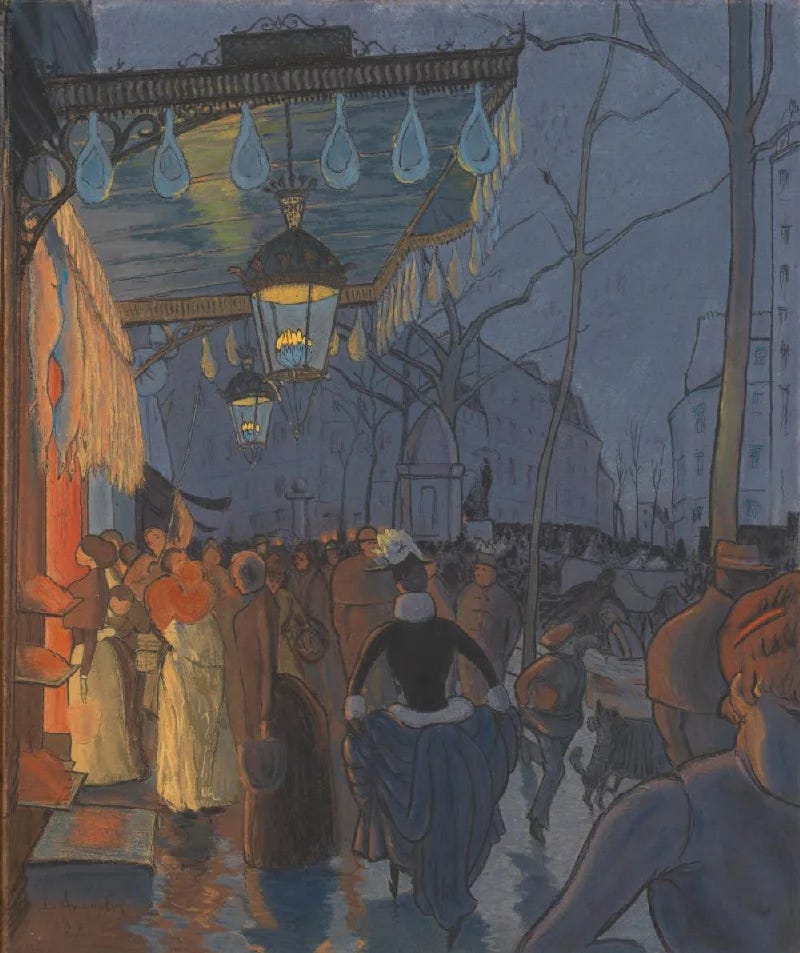
In 1888, the critic Édouard Dujardin described the work of his friend Louis Anquetin by making a comparison to medieval enamels. Dujardin noticed that Anquetin placed his colors in discrete blocks within defined outlines, rather than shading them continuously.
At first sight, his works proclaim the idea of decorative painting: traced outlines along with strong and fixed coloration. Outline is quasi-abstract sign, gives the character of an object; unity of color determines the atmosphere, fixes the sensation. From this derives the circumspection of outline and color as conceived by popular imagery and Japanese art. The artists of the ‘’image d’Epinal’‘ and Japanese woodcut albums first trace lines within which are placed colors according to the ‘’color pattern’‘ process. Likewise, the painter Anquetin traces his design with enclosing lines, within which he places his various color tones juxtaposed in order to produce the desired sensation of general coloration. Drawing predicates color and color predicates drawing. And the work of the painter will be something like painting by compartment, analogous to cloisonné works of art, and his technique consists in a sort of cloisonnisme’ [emphasis added]
In La Revue indépendante (1 March 1888) / christies.com
This reminded Anquetin of the way that medieval enamels had their colors divided, separated, or enclosed (like cloister, claustrum or enclosure) in what is called the cloisonné technique.


Anquetin thought that this approach to color “determines the atmosphere, fixes the sensation,” and gives the “desired sensation of general coloration.” It would go on to be taken up by painters such as Émile Bernard and Van Gogh (Wadsworth / Van Gogh Museum), and be important for Post-Impressionism in general.